Gutter and Downspout Extensions in Eau Claire, WI
A gutter only collects the water. Where each downspout lets it go decides whether a roof’s worth of rain soaks the soil against your basement wall or runs off across the yard. We add and re-route downspout extensions, set splash blocks, add downspouts where one is overloaded, and bury downspout lines out to a pop-up emitter or a daylight outlet.
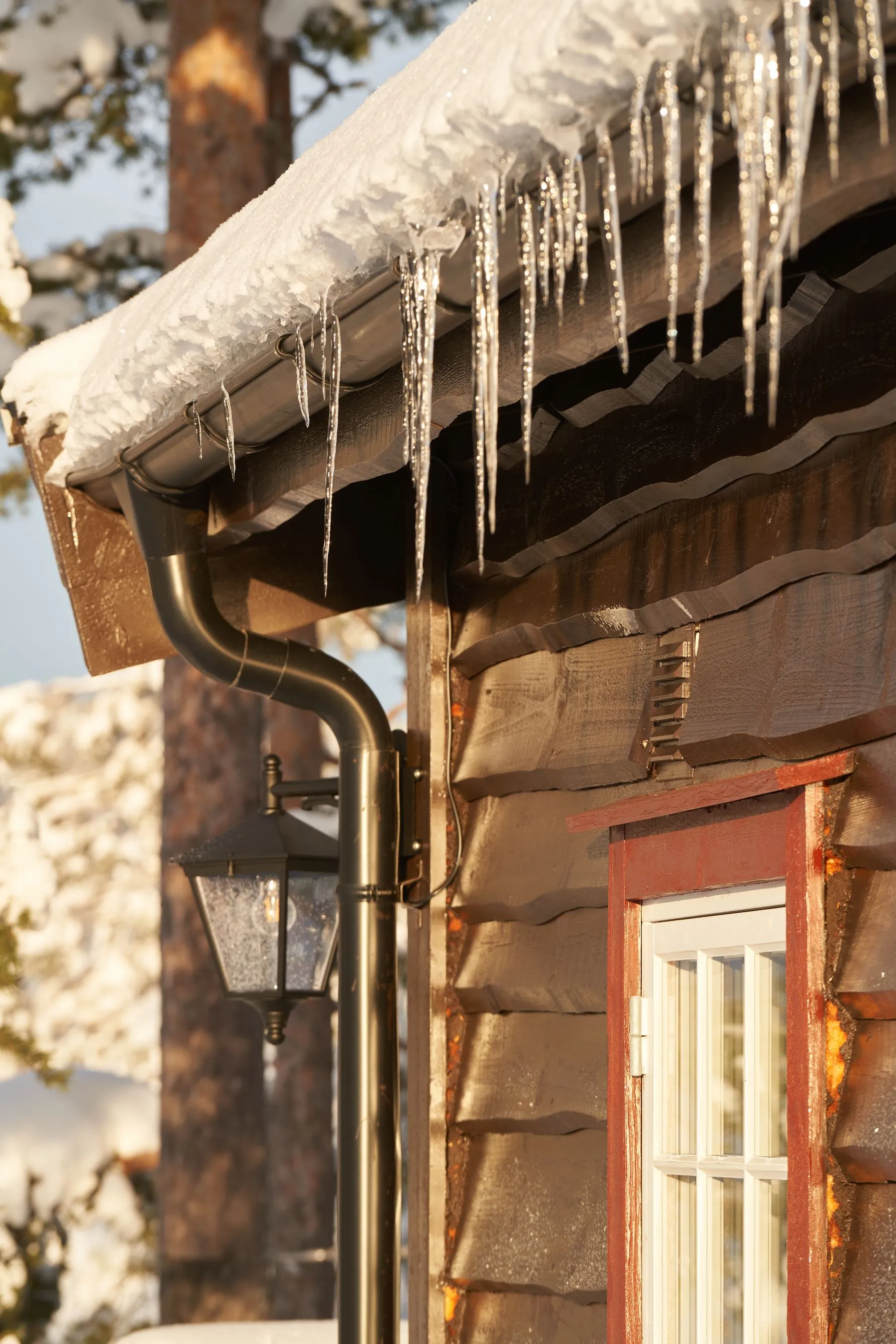
How Far Downspout Extensions Should Carry Water
Before you buy anything, walk the house after a hard rain or on a melt afternoon and look at where each downspout’s water actually lands. That one walk tells you more than any rule of thumb.
Five-minute downspout check
- Measure from the foundation wall to the spot where water leaves each extension or splash block.
- Look past that spot: does the ground keep falling away from the house, or is it flat or tipped back toward the wall?
- Check the elbow at the bottom of each downspout for crushing, separation or a missing extension.
- Note any outlet that empties onto a driveway, sidewalk, patio or the neighbor’s side of the lot.
- Match each outlet to the basement corner inside. A damp corner under a short outlet is rarely a coincidence.
Then compare what you found with the published numbers. They don’t agree on a single distance, mostly because they are measuring different things:
- Wisconsin Uniform Dwelling Code, SPS 321.12 Sets no downspout length. It governs the ground instead: finished grade must slope away from a dwelling at least 1/2 inch per foot for at least 10 feet, and paved surfaces next to the house must slope away for 10 feet at an equivalent rate. Wisconsin applies this code to new one- and two-family homes rather than the International Residential Code.
- International Residential Code, R801.3 Where expansive or collapsible soils are known to exist, roof water must discharge at least 5 feet from foundation walls or into an approved drainage system (as summarized by InterNACHI). Building officials differ on whether it applies to slab-on-grade homes.
- This Old House Choose an above-ground extension that reaches at least 4 feet from the foundation, longer if the grade calls for it; a buried line should carry water at least 10 feet away.
- Angi Buried downspouts should discharge at least 5 to 10 feet from the foundation, depending on local code, soil and slope.
Read together, 4 feet is a floor for an above-ground extension, not a target. The goal is to get water past the loose backfill beside the basement wall and onto ground that is still falling away from the house. On a lot graded the way the Wisconsin code describes, that sloped band runs about 10 feet out, so the closer an outlet gets to the far edge of it, the less water finds its way back. Soil changes from one lot to the next around Eau Claire, Altoona and Chippewa Falls, so a splash that disappears in seconds on one yard can sit in a puddle two streets over. Watch where yours goes.
Signs your downspouts dump too close to the house
- A damp or wet basement corner directly under a downspout, worst after a spring melt or a long rain.
- White, powdery efflorescence on the foundation wall, inside or out, near an outlet.
- Mulch washed out of a bed, a bare gully, or a sunken dip right where the water exits.
- A front stoop, patio slab or walk that has settled and tipped back toward the house.
- An ice sheet at the back door or across the driveway every time the snow melts.
- Splash-back staining or worn paint on the bottom courses of siding beside the downspout.
Downspout Extension Work We Do Around Eau Claire
We do this work whether the gutters are going up new or have hung on the house for twenty years. On a visit we look at every outlet, not just the one that prompted the call, because water that is moved away from one corner often ends up at the next.
- Extensions on every outlet: fixed aluminum sections in the same profile as the downspout, or hinged flip-up extensions where you mow or clear snow.
- Re-routing: swapping or turning elbows so discharge heads for the lawn instead of the driveway, the walk or the neighbor’s yard, and replacing crushed or disconnected elbows.
- Splash blocks set under outlets where the ground already falls away well.
- Added downspouts where one outlet is carrying more roof than it can, which is often the real reason an extension seems to “not work.”
- Underground downspout drains: a buried solid line from the downspout out to a pop-up emitter or a daylight outlet on lower ground.
Downspout extensions on a new gutter system
When we hang new gutters, downspout placement and discharge are planned with the runs, and every downspout leaves with an extension, splash block or connection that carries water several feet out from the foundation. If the whole system is due, start with our seamless gutter installation page.
Adding gutter extensions to an existing system
Often the gutters are fine overhead and failing at the bottom: an extension mowed off years ago, an elbow pointed at the patio, a buried line that quit draining. We fix the outlet end without touching the rest. If the runs themselves sag, leak or overflow, that is a gutter repair problem first, and clogged runs need gutter cleaning before any extension can help.
Flip-Up, Roll-Out and Fixed Gutter Extensions Compared
Every option below moves water. The differences show up in July with a mower and in January with a snow blower, and that is usually what decides it.
| Option | Reach | Mowing & snow | In an Eau Claire winter | Upkeep | Best for |
|---|---|---|---|---|---|
| Fixed aluminum extension | As long as the section you cut, commonly a few feet | Mow and blow around it; easy to clip and bend | Works if it pitches downhill; ice can build at the open end | Gets bumped loose at the elbow over time | Side yards and beds you never mow through |
| Hinged flip-up extension | Same as a fixed section | Swings up out of the way for the mower or snow blower | Can freeze in the up position; must be down to drain | Hinge rivets loosen; someone has to remember to lower it | Outlets along a lawn edge or a path you clear |
| Roll-out sleeve | A few feet, only while water is flowing | Lies flat; easy to mow over or tear | Freezes flat and stuck; can split under snow load | Plastic wears out in sun; replace every few seasons | Front-yard outlets where a pipe would look out of place |
| Flexible corrugated (accordion) | Stretches to several feet; can bend around corners | Easy to move, easy to crush | Ridges hold water that freezes in place | Collects grit; cracks with age | Temporary fixes and awkward angles |
| Splash block | Only its own length | Mow around it; plows and blowers can catch it | Gets buried in snow; outlet can ice over it | Re-set it when it tips or sinks | Ground that already falls away steeply |
| Underground downspout drain | As far as the trench can keep falling | Nothing above grade but a flush emitter or an outlet pipe | Emitter can ice shut; low spots in the line hold ice | Needs a cleanout or catch basin you can flush | Driveway sides, walks and long, open lawns with a lower spot to drain to |
Fixed and flip-up downspout extensions
A fixed aluminum section is the plainest answer and the one that lasts. It slips over or into the bottom elbow, matches the downspout, and stays where you put it, which is also its weakness: it is in the way of anything with wheels. A hinged flip-up uses the same kind of section on a hinge, so it swings up for mowing or snow clearing and drops back down to drain. The catch is people. A flip-up left up through a thaw drains straight down at the foundation, which is the exact thing it was installed to stop.
Roll-out sleeves, flexible extensions and splash blocks
Roll-out sleeves unroll when water pushes through and curl back up when it stops. They are tidy in a front yard and they don’t survive much: sun, mowers and ice all shorten their life. Flexible corrugated extensions are handy for reaching around a corner or a planter, but the ridges hold grit and water. A splash block only spreads water at the base of the downspout, so it works where the ground already drops off fast and does little on a flat yard.
Underground Downspout Drains: Buried Lines, Pop-Up Emitters and Daylight Outlets
An underground downspout drain connects the bottom of the downspout to a buried pipe that carries the water out to an outlet farther from the house. Done right, there is nothing to trip over or mow around, and the water can travel well past the reach of any extension. Done wrong, it is an out-of-sight clog that dumps water at the foundation and that nobody notices until the basement does.
Solid pipe, steady slope and a cleanout
The line from the downspout should be solid, not perforated. Perforated pipe is meant to let water out along its length, and the first stretch of a downspout line runs through exactly the soil you are trying to keep dry. This Old House recommends solid PVC for carrying water to a lower part of the yard and a trench that falls away from the house at least 1/4 inch per foot. A steady fall matters more than the pipe brand, because any belly in the line holds water, silt and, in winter, ice. Roof runoff carries shingle grit and leaf bits with it, so the top of the line needs a way in: a cleanout, or a catch basin with a debris screen at the downspout, lets you flush the line or run a snake without digging it up.
Pop-up emitter or daylight outlet
A pop-up emitter is a cap at the end of the line that sits flush with the lawn and lifts when water pushes up from below, then drops closed. It needs the outlet to be lower than the downspout, or the water simply sits in the pipe. A daylight outlet is better when the yard allows it: the pipe exits on a slope, into a swale or onto lower ground with an open end, so water drains out on its own and there is no lid to freeze shut.
When a buried downspout drain is the wrong choice
Burying a line is not automatically the better job, and we will say so on the visit. It is the wrong call on a flat lot with no lower spot for the water to reach, through dense tree roots, or where a ten-dollar extension already lands water on ground that falls away. It also trades a problem you can see for one you can’t: a flip-up that is left up is obvious, while a crushed or iced line can fail quietly for a season.
Frozen Downspout Extensions in January
Winter here isn’t one long freeze. Sunny afternoons melt snow off the roof, the water runs down the downspout, and it refreezes as the sun drops. Each cycle leaves a little more ice at the coldest point in the path, which is usually the outlet.
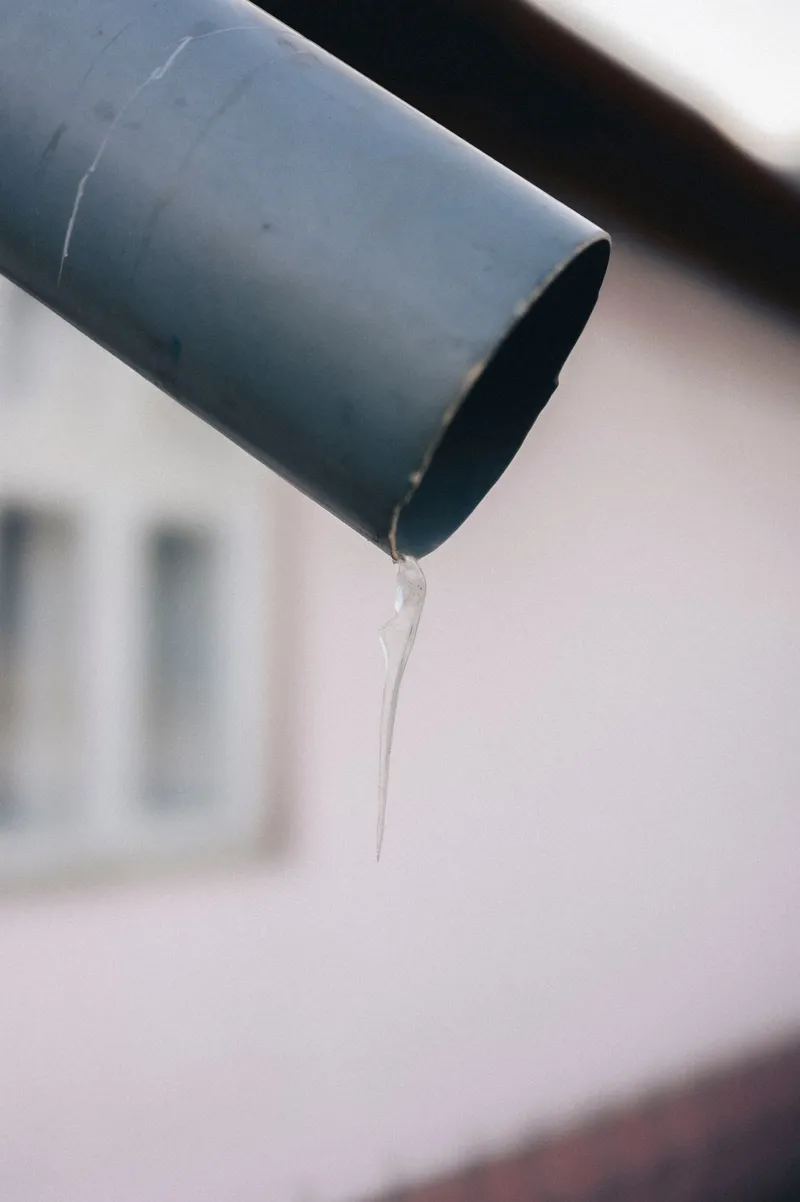
Why underground downspout lines ice up at the emitter
Wisconsin’s dwelling code requires footings to sit below the frost penetration level or at least 48 inches below grade, whichever is deeper (SPS 321.16). That is how deep the state expects frost to reach. A downspout drain runs in a shallow trench far above that, so in a cold stretch the whole line sits in frozen ground. Any water left standing in a low spot or under the emitter cap freezes there, the pop-up lid freezes shut, and the next melt backs up the line and out at the bottom of the downspout, right next to the foundation. Angi’s downspout guide makes the same point: buried downspouts can freeze as cold water runs through them. That is why we push for steady slope, a daylight outlet where the yard allows one, and a way to send winter melt to an above-ground extension when the line is frozen.
What to do when a downspout extension freezes solid
- Check every flip-up is down. One frozen in the up position drains straight down the foundation all winter.
- Kick snow and ice away from the outlet end so the next melt has somewhere to go.
- If the downspout itself is iced, hot water poured carefully down from the top can open it, as Angi suggests. Don’t hammer on aluminum; it cracks and dents, and a bent elbow drains worse in spring.
- If water is backing up and spilling over the front of the gutter on a mild day, the downspout or the outlet below it is plugged. That ice is heavy and can pull a run off the fascia, which is a gutter repair call.
- Icicles along the whole eave are a different problem: ice dams from attic heat loss, which no extension will fix.
Keeping downspout discharge off driveways and sidewalks
Meltwater that crosses a driveway, a walk or a step at 3 p.m. is a sheet of ice by 6 p.m. Every outlet near a door, a garage apron or a sidewalk should be turned toward lawn or a bed, even if that means a longer extension, a second elbow, or a short buried run under the walk. It is the cheapest slip-and-fall fix on the house.
Where Downspout Discharge Can Go, and Where It Can’t
- Not into the sanitary sewer. Wisconsin’s plumbing code says storm and clear water drain piping may not discharge to a sanitary building drain that connects to a public treatment plant (SPS 382.30(11)(g)2). On older homes, a downspout that disappears into a pipe in the ground near the foundation is worth tracing before anyone assumes where it goes.
- Not onto the neighbor’s lot. Pointing a concentrated stream of roof water at the property line moves the problem next door and starts arguments. Keep it on your own ground.
- Not across walks and drives. See the January problem above.
- City connections are the city’s call. Before tying a downspout line into a storm sewer, a curb or a street ditch, check with the City of Eau Claire, or your own town or village outside the city.
- Good destinations: open lawn that keeps falling away from the house, a low spot or swale already on the property, or a rain barrel with its overflow pointed the same way.
What downspout extensions can’t fix
Extensions and buried downspout lines deal with roof water. They do nothing for water that is already in the ground, and some problems that look like a downspout issue belong to other trades:
- Negative grading. If the yard slopes toward the house, water from anywhere will end up at the wall. Regrading is landscaping or excavation work, not gutter work.
- Foundation drain tile and French drains. Perforated pipe in gravel that collects groundwater is a drainage or excavation contractor’s job.
- Sump pump discharge. Running a sump line to daylight is plumbing; keep it separate from the downspout line.
- Basement waterproofing and dry wells. Both belong to waterproofing and drainage specialists.
We don’t do any of those, and if the visit points that way, we will tell you so rather than sell you extensions that won’t help.
What Downspout Extensions and Underground Drains Cost
The honest starting point: a basic downspout extension from a hardware store fixes a lot of these problems, and you don’t need us to install it. Fixr puts average downspout extensions at $2 to $17 and splash blocks from around $6 for plastic up to $85 for high-end bronze. HomeGuide lists splash blocks or extensions at $10 to $50 per downspout as part of a gutter job.
Buried lines are a different scale of job. HomeAdvisor lists underground downspouts at $200 to $2,000 each. Short, simple runs sit at the low end, which matches our seamless gutter cost guide describing underground downspout drainage as an add-on of a few hundred dollars; long runs, a catch basin, or a path under a walk push it up.
Where we earn our keep is the part a store-bought extension can’t reach: elbows that need re-routing, a downspout that needs adding, a line that needs burying with real slope and a cleanout, or a whole house where every outlet needs rethinking at once. Each of those is priced on its own line in a free written estimate, so you can do the easy ones yourself and hand us the rest.
Related services
Get Your Free Eau Claire Estimate
Downspouts dumping against the house, a flip-up that never stays down, or a line you'd like buried out to the yard? Tell us what's going on and we'll set up a free on-site visit with a written price range — no obligation, no pressure.
Prefer to talk? Call 715-705-8272.
Frequently Asked Questions
How long should a downspout extension be?
At least 4 feet for an above-ground extension, as This Old House recommends, and longer when the yard is flat. The real target is ground that keeps falling away from the house. Wisconsin's dwelling code grades new homes to slope away at least 1/2 inch per foot for the first 10 feet, so the closer the outlet lands to that 10-foot mark, the better.
Should I bury my downspouts or use flip-up extensions?
Bury them when there is a lower spot in the yard for the line to drain to and the outlet is somewhere an extension gets in the way, like a driveway edge or a walk. Use flip-up extensions when the ground already falls away and you just need the pipe out of the mower's path. On a flat lot with nowhere lower to send the water, a buried line usually isn't worth it.
Do underground downspout drains freeze in Wisconsin?
They can. The line sits in a shallow trench, well inside the frost zone, so water left in a low spot or under a pop-up emitter freezes, and the next melt backs up at the downspout. Steady slope, solid pipe, a daylight outlet where possible, and a way to send winter melt to an above-ground extension all reduce the risk.
Can downspouts drain into the sewer in Eau Claire?
Not into the sanitary sewer. Wisconsin's plumbing code bars storm and clear water drain piping from discharging to a sanitary building drain connected to a public treatment plant. Before tying a downspout line into a storm sewer, curb or ditch, check with the City of Eau Claire or your own municipality.
Do you install French drains or sump pump lines?
No. We handle roof water: downspout extensions, splash blocks, re-routed elbows, added downspouts and buried downspout lines to a pop-up emitter or daylight outlet. French drains, foundation drain tile, sump pump discharge, basement waterproofing, dry wells and yard regrading are other trades' work, and we'll tell you if that's what your house needs.
Is a splash block enough?
Only where the ground already drops away steeply from the house. A splash block spreads water across its own length and no farther, so on a flat or back-sloped yard the water soaks in right beside the foundation. Swap it for an extension, or add one ahead of the block, so the water lands farther out.
Free Estimates Across Eau Claire & the Chippewa Valley
Serving Eau Claire, Altoona, Chippewa Falls, Menomonie, Lake Hallie and surrounding communities. Honest written pricing, no pressure.